Some basic things about this lot that I cannot change:
- Looking out towards the back yard, the property to our right (north) is a few inches higher in elevation, and the property to our left (south) is a few inches lower. The overall flow of water in heavy rain moves from right to left.
- Fencing that encloses the back yards starts at the back of the house, so there is no border that separates neighboring properties between the houses. Looking at other properties in this development, I expect the turf between us and our neighbors to be graded in a V-shape so that excess water runs down to the street and then into the main drains. (The neighboring lots beside us aren’t turfed yet.)
These next photos are of the left and right boundaries to our lot.


Things that I saw after we had a day of heavy rain following weeks of drought (i.e., the ground was dry and hard):
- Soil was readily moved around where there were no plants. Even the Bermudagrass sod in the back which will eventually be removed or killed was useful in retaining water.
- Some soil and a lot of water was lost to the neighboring lot on the left (south) side. These photos are during the rain event and then the day after, same location, different directions.


- A rainfall of approximately 0.5 inches was enough to fill two 55-gallon rain barrels, even without gutters.
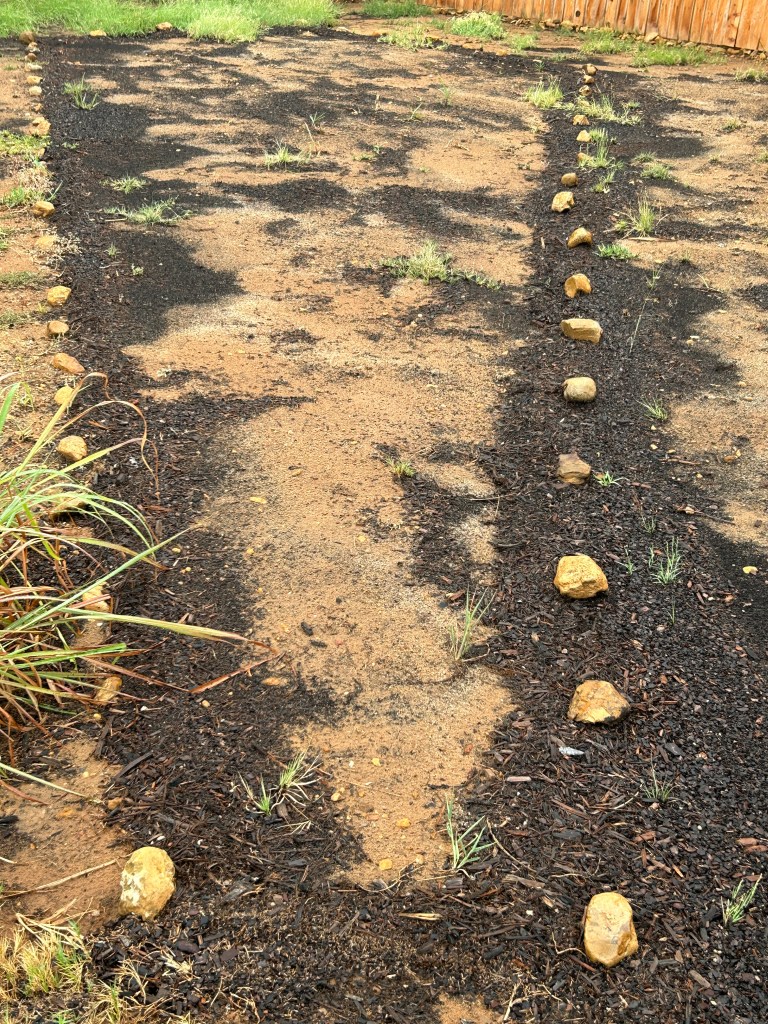
- Apart from one location on the south side where the water flow was the strongest (see above photos), other places where I had short (a couple of inches tall) mulch barriers were sufficient to prevent soil from moving any further. Mulch seems to hold its position quite well in rain. In this photo, the stones mark where there are lines of mulch. Water moved from right to left.
Future things that I can consider doing:
- After the property to the south side of us is turfed, build up my border wall so that there is less soil erosion on that side. I might also add a strip of mulch to help to trap water. I am not trying to prevent all water loss on that side. Given our relative position in the development, it’s necessary that excess water moves off our land in the way that the builder intended. However, I’d prefer to retain as much water as our ground will hold, and to prevent all soil loss.
- Before my seeding projects in the fall, put more mulch down in strips as dams to minimize soil movement. That will define smaller areas so that if soil does move, it doesn’t travel as far and is less likely to leave the property altogether. For instance, the perimeter area for native grasses is defined as one area, but especially on the south side I could split it into smaller sections.
- After seeds are sown in the fall, cover them with a thin layer of mulch. I don’t want to bury seeds too deeply — wildflowers naturally propagate themselves by scattering seeds on the surface of soil. Last time I used soil, but mulch might stay in place a little better.


 Rewilding My Lot
Leave a comment