
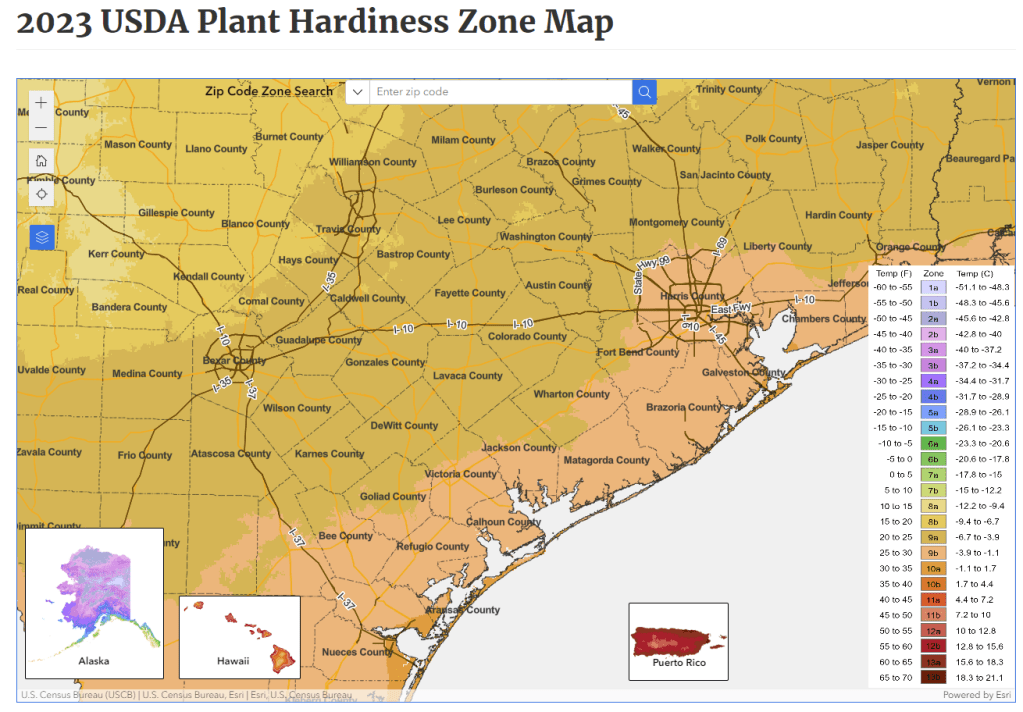
The USDA Plant Hardiness Zone Map is helpful to determine how perennial plants will tolerate living in your particular area. The map is based on the average annual extreme minimum winter temperature. A good nursery will label their plants or seeds according to which zones will suit them. Note that this map is a indicator of winter hardiness, and provides no data about how hot different regions get.
Until recently, Seguin was defined as being in Zone 8b and Houston (where I lived for 36 years) was 9a. They are neighboring zones and a lot of plants will grow just fine in both regions, but there are differences as well. Of course, there are many other factors that determine whether a plant will thrive, such as soil type, light, moisture, and humidity. In reality, those other factors have been more relevant to me in choosing plants for here. For instance, compared to my Houston garden, my Seguin lot has 20 inches less rainfall per year and is in full sun vs. part shade.
In 2023, the Plant Hardiness Zone Map was revised (the previous version was published in 2012), and now Seguin (Guadalupe County) lies in Zone 9a (Houston now lies within Zone 9b). In other words, the average winter extreme low temperature has risen, and this has occurred not only here, but throughout the country. There is more information on how the map is created here.

 Rewilding My Lot
Leave a comment