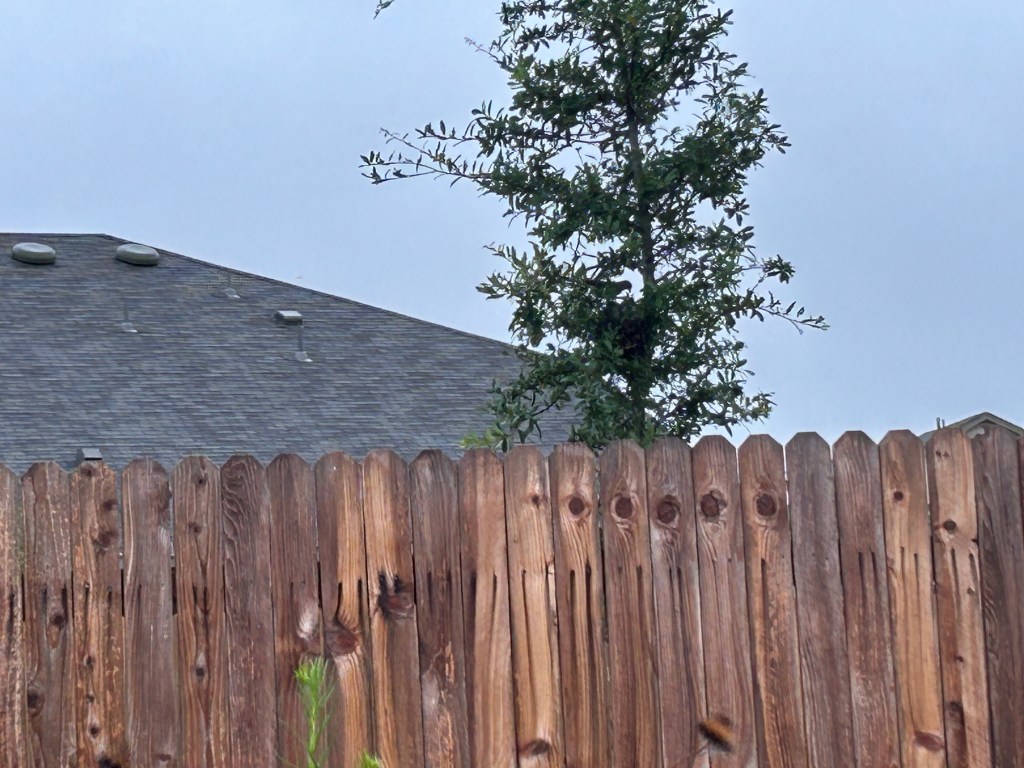
In a new housing development with no mature trees, there is not much opportunity here for birds to build nests yet. However, I’ve spotted one that is about half-way up a neighbor’s 12-foot oak tree. I can see the nest from our back patio.
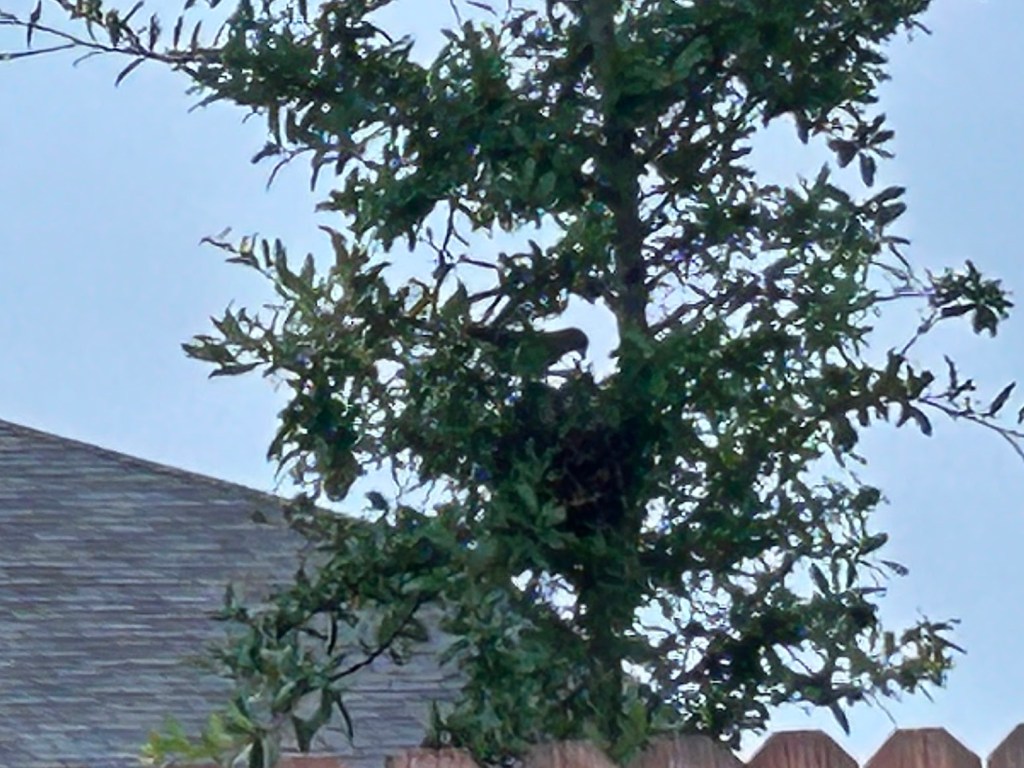
Here’s a close-up of the photo above, where you can see the silhouette of a parent bird feeding chicks.
The beginning of this story was that a Northern Mockingbird (Mimus polyglottos) started to come often to our back patio, stand on the back of the chairs, and squawk towards the house. This, of course, was highly aggravating to our two indoor cats.

A friend knowledgeable about birds suggested that there might be a nearby nest and that this sounded like defensive behavior. I knew there were no nests in our own back yard, so I started looking around to the parts of those neighboring trees that I could see and indeed found a nest in one of them.
This is what I’ve noticed by observation: There are already chicks in the nest, big enough that I can see their open mouths when a parent comes with food. I think there might be three babies, but I can’t really be sure. There are two adults feeding the chicks and they are very similar so I can’t tell them apart. It usually takes the parents only a few minutes to return with food, so they are not going far to find it, and (disappointing to me) they are not finding what they want in my garden.
So those have been my observations, and the following is a small part of what I have discovered from reading, mostly from this Wikipedia entry:
Northern Mockingbirds are omnivores, feeding mostly on arthropods (e.g., spiders, grasshoppers, ants, beetles, and caterpillars), earthworms, berries, fruits, seeds, and occasionally small crustaceans and lizards. During the breeding season, they are more likely to seek animal prey, switching to a primarily vegetarian diet in fall and winter.
A Northern Mockingbird breeding pair can stay together for several years. They are both involved in nest-building and feeding of chicks. The female usually lays 3-5 eggs and incubates them for 11-14 days. Offspring become independent 10-15 days after hatching. There may be 2-4 broods per year and the same nest may be used during a breeding season.
Mockingbirds aggressively defend their nests against other birds, animals, and humans.
I’ve been preparing this post for several days, so here’s one more story before I publish.
The chicks were already hatched before I noticed the Mockingbird nest, so I knew I only had a few days before they’d be off on their own. So every morning I’d spend a few minutes watching the nest. On this day I saw a bird standing over the nest, but I thought it was smaller than the parents. Perhaps a chick?

Sure enough, after a while it disappeared down into the nest and soon afterwards a parent came with food.
Then that parent, apparently not caring for me being where I was, flew down to the fence near me and gave me a stern look.
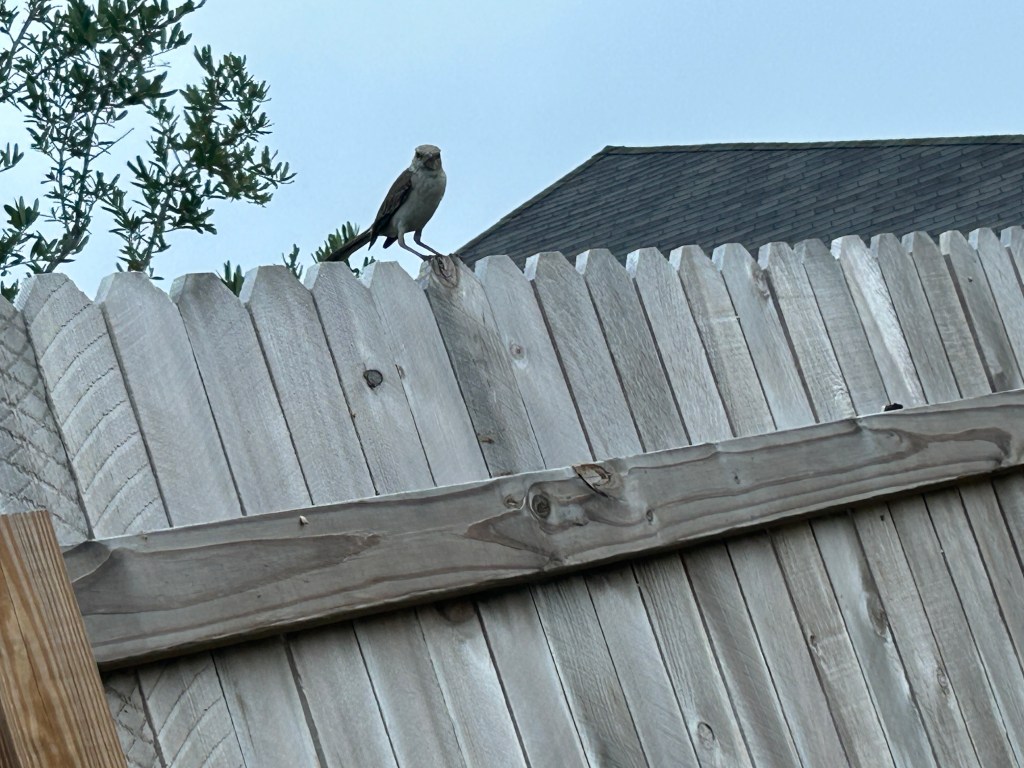
He/she made a sound that I hadn’t heard before. I assume it was a call for reinforcements, because very shortly thereafter the second parent arrived.
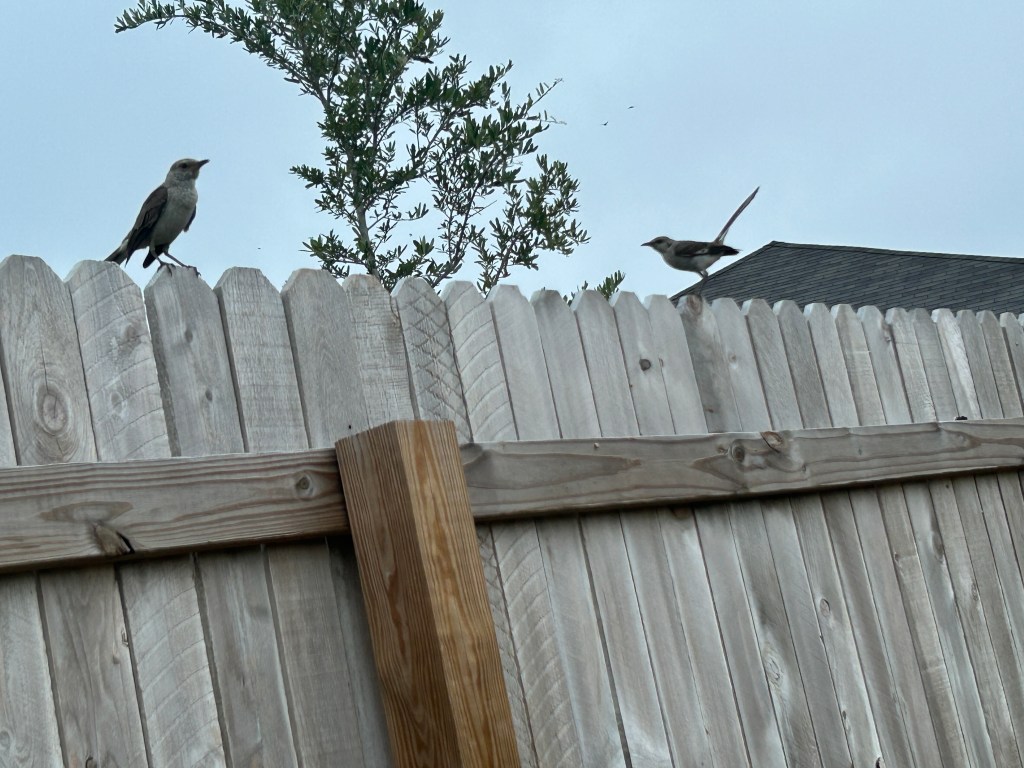
Parent #2 then flew up into the tree behind to assess the situation.
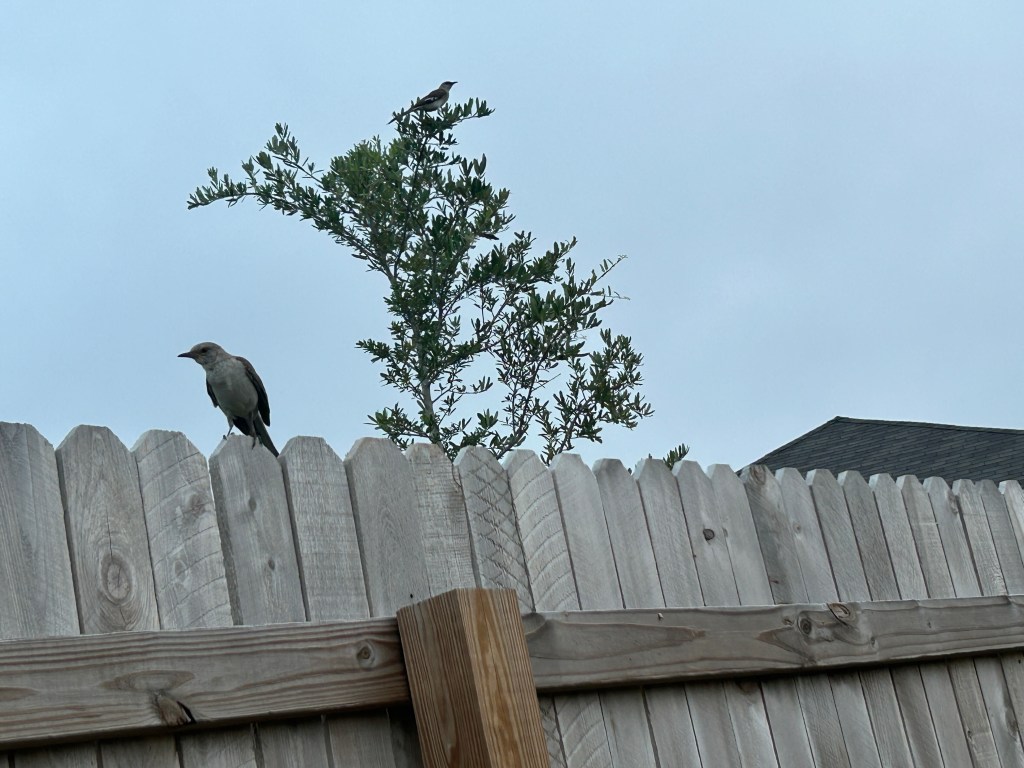
And from there it went directly to the patio to yell at the cats.
These birds are clearly feisty and intelligent. I may have to watch my back while gardening near their nest.

 Rewilding My Lot
Leave a comment