Ideally I install new plants in the fall so that they don’t have to endure a hot summer when they are still getting established. However, there are a few exceptions that happen:
- A fall-blooming shrub planted in the spring and nurtured through the summer may bloom in its first year.
- I have blank spaces that I’d prefer to fill quickly.
- I finally find a plant that I’ve been seeking for a long time.
- I’m just tempted.
In spring 2026, all four of these things have happened.
1. FALL-BLOOMING SHRUBS
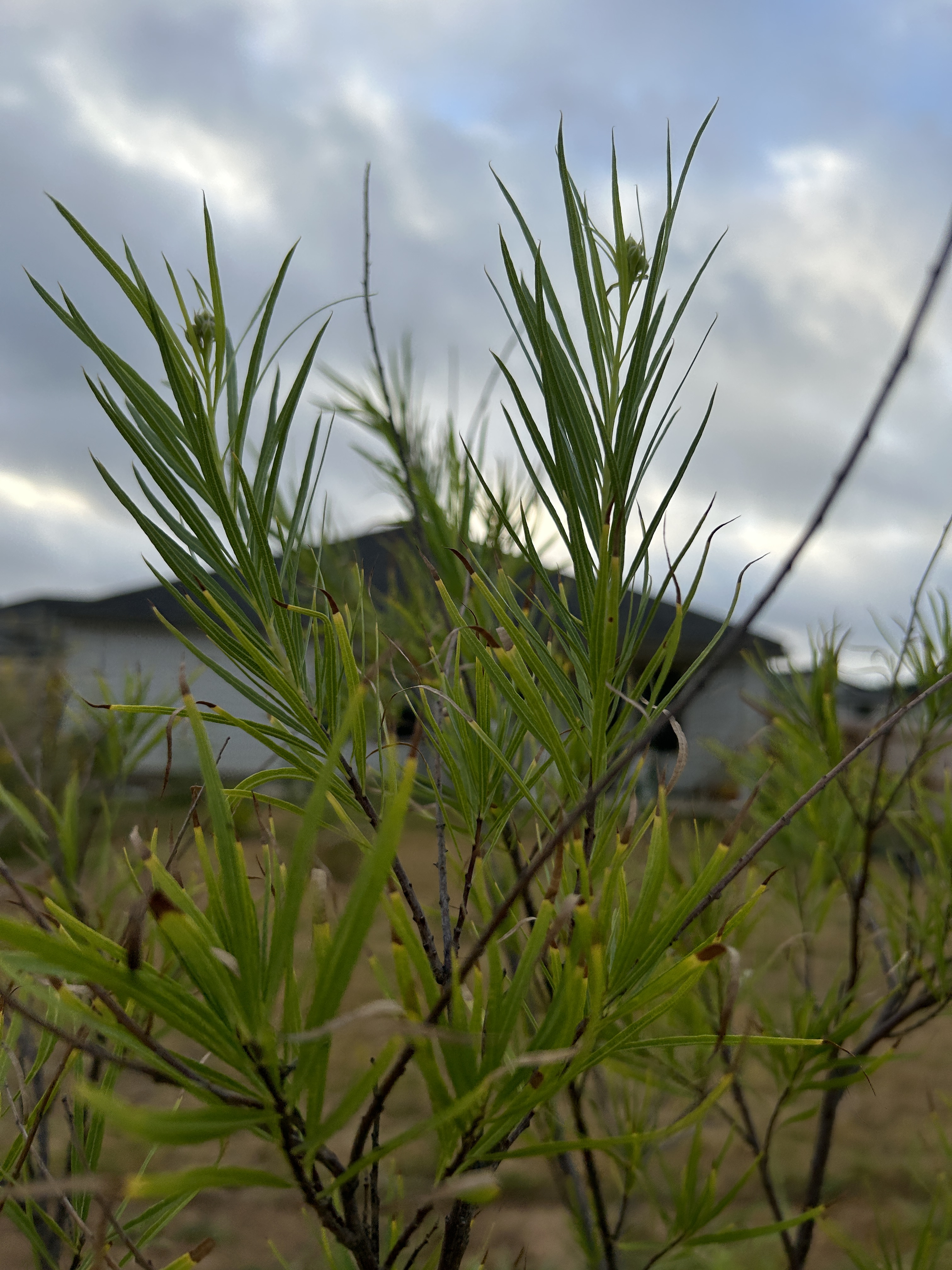
I have wanted to add an Esperanza (Tecoma stans) to the garden here since last year. This is a very drought-tolerant shrub that in its most common form is large (up to 8 feet tall) and with yellow blooms. I am normally wary of cultivars, because sometimes they can end up not being as useful to wildlife as the original. However, from a supplier (Ecosystem Regeneration Artisans) and seller (Pollinatives) that I trust, I have acquired a variant of Esperanza called “Compact Orange” that should be shorter (up to 4 feet tall) and with orange blooms. By planting this in the spring, I have the chance of getting some blooms this year. In fact, there are already buds on this plant.
2. FILLING BLANK SPACES
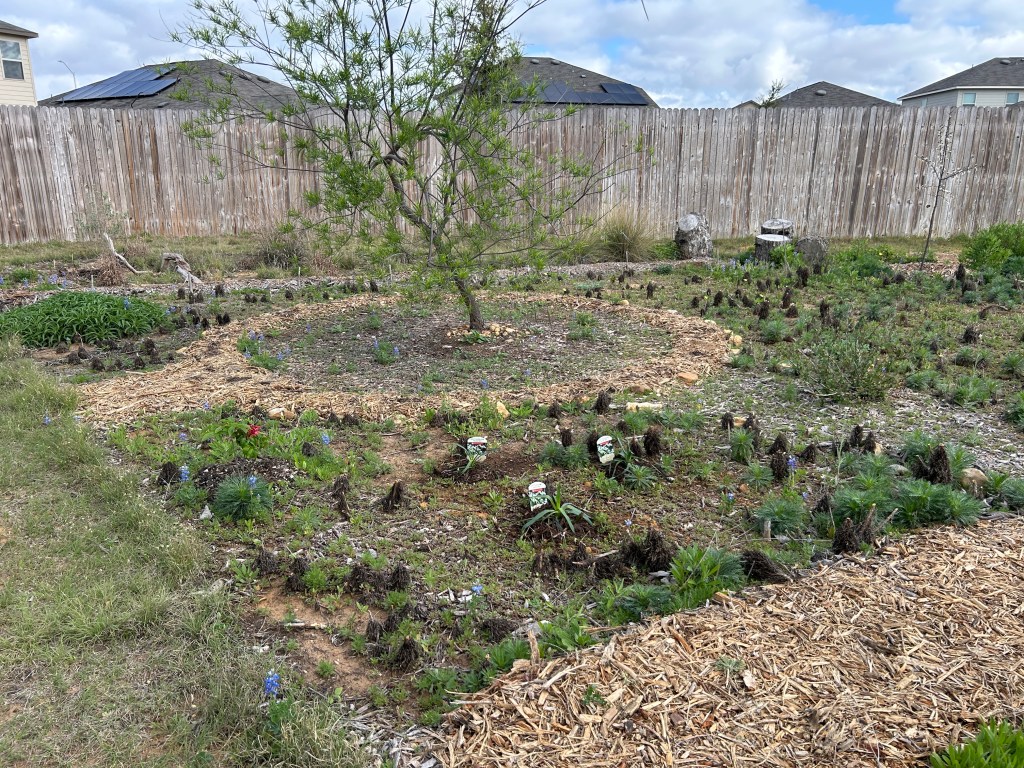
I still have some blank spaces in front of the pond, and on the berm behind the pond that covers the waterfall. I’d rather have plants in the ground to reduce the change of soil erosion, so I bought three things to address that.
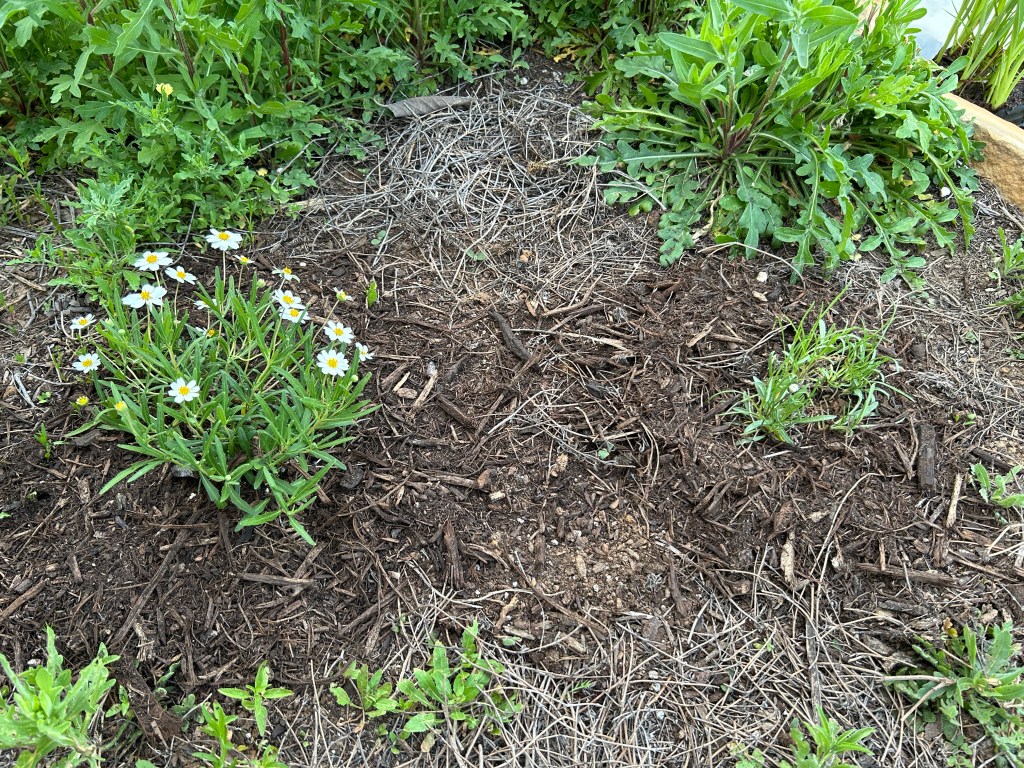
There is one Blackfoot Daisy (Melampodium leucanthum) plant already behind the pond, but the plants that were in front of the pond didn’t survive last winter. I bought one replacement Blackfoot Daisy to see if it will fare any better.
For the same location in front of the pond, I bought four small Four-nerve Daisy (Tetraneuris scaposa) plants. This is something that I was looking for last fall but couldn’t find.
In this photo, the new Blackfoot Daisy is on the left and a small Four-nerve Daisy is on the right.
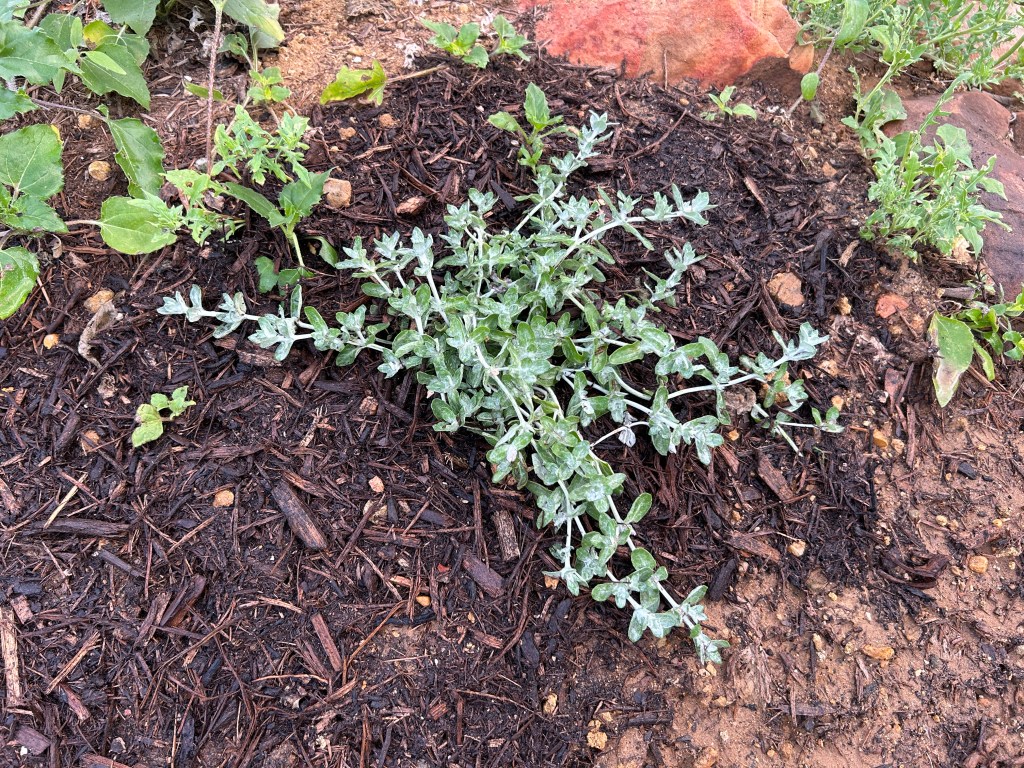
The berm behind the pond isn’t properly populated with plants yet. Ideally, what I want is low growing ground cover that will hold the soil down, and for this purpose I bought a Woolly Stemodia (Stemodia lanata).
3. FINALLY FINDING A PARTICULAR PLANT I WANT
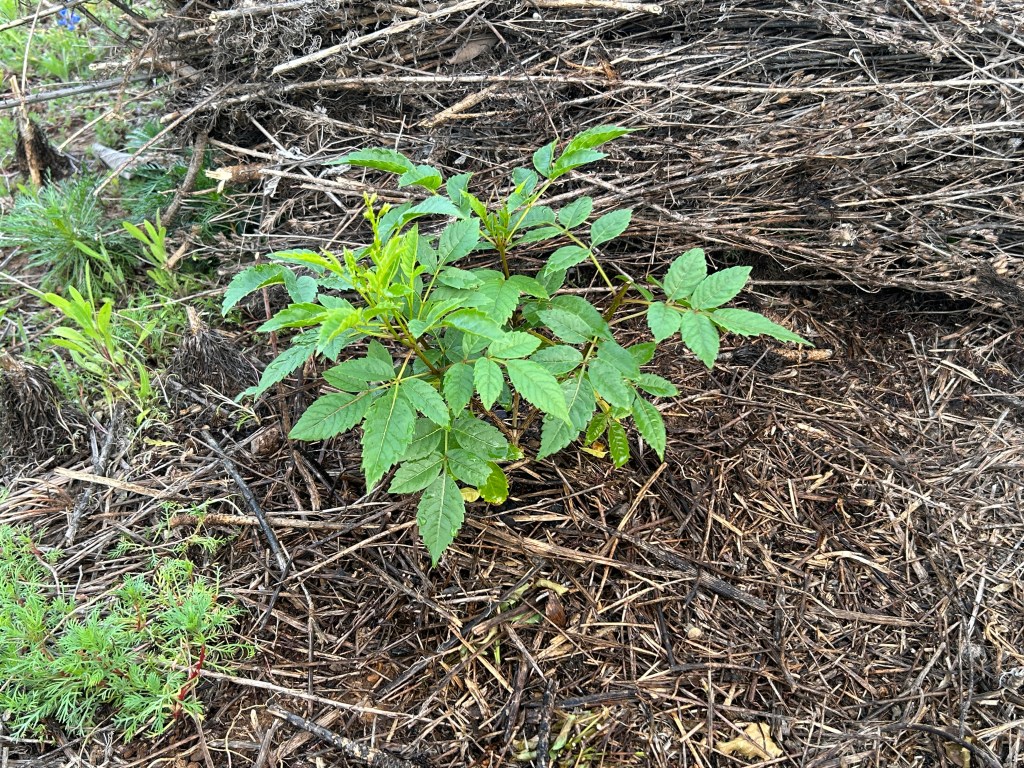
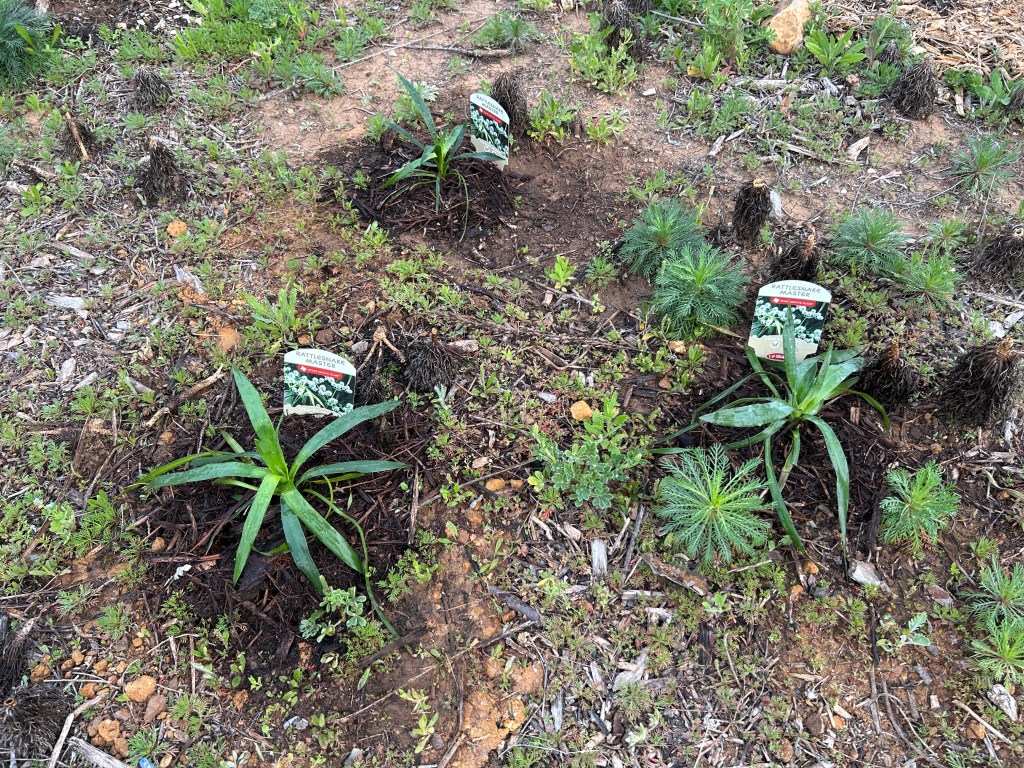
In my Houston garden I had two Rattlesnake Master (Eryngium yuccifolium) plants. They are interesting and I’ve wanted to have them here since I arrived three years ago. I made a couple of attempts at sowing seed in my early time here, but with no success, and for more than a year I’ve been hoping to find an established plant that I could introduce. Finally, in H-E-B’s native plant sale, I found them and so I snagged three. I’ve planted them in a group near the back of the garden. Here’s a close view, and the photo at the top of this post is a wider view of the same area.
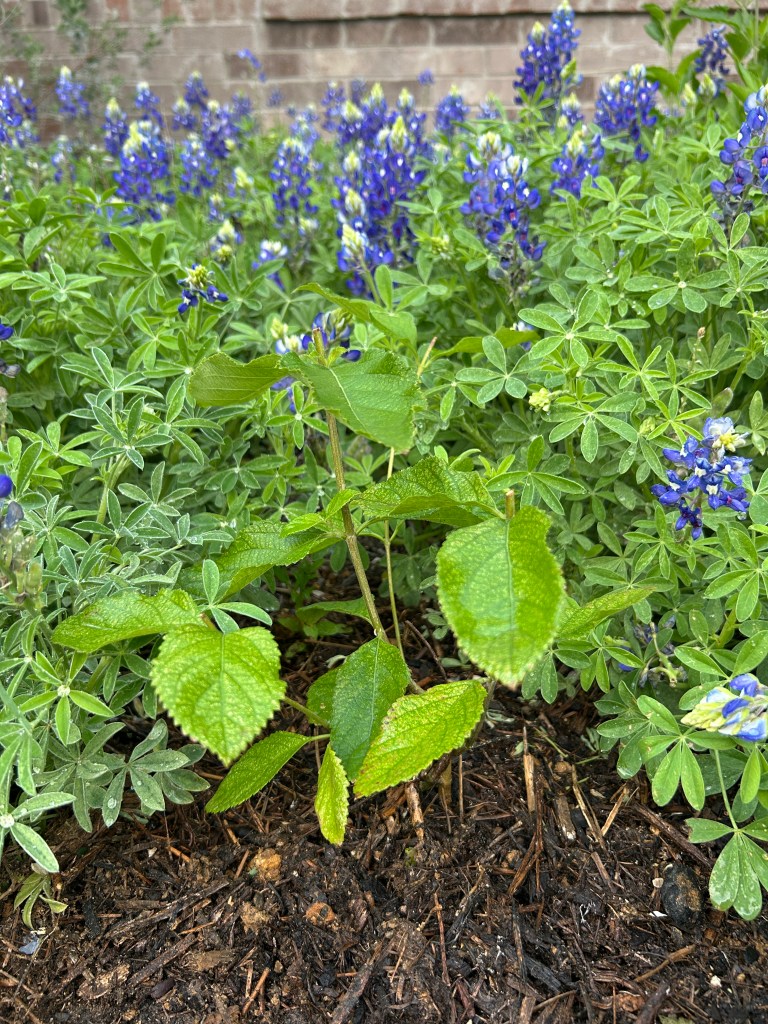
Almond Verbena (Aloysia virgata) is more common south of the USA, but it does also occur in Texas. This large shrub (up to 10 feet tall) has a strong pleasant fragrance and is a popular source of food for our native pollinators. When I went looking for one last fall, everywhere I went had sold out. Green Jay Gardens even sold out of their first batch early this spring, but Almond Verbenas were back in stock by the time I returned a couple of weeks later. At the time of planting, I cut the stems down to about half their height to encourage a more bushy growth. At the moment, the Almond Verbena is dwarfed by its bluebonnet neighbors, but I don’t expect that to last long!
4. SUCCUMBING TO TEMPTATION
Sometimes when I am out and about I encounter opportunities to buy plants even when I wasn’t planning to. I am more restrained now than I used to be, and I have learned to check with the Native Plant Society of Texas native plant database before I come home with something new. Another scenario is when I have the chance to buy another pot of something I already have that I know will do well in the garden.
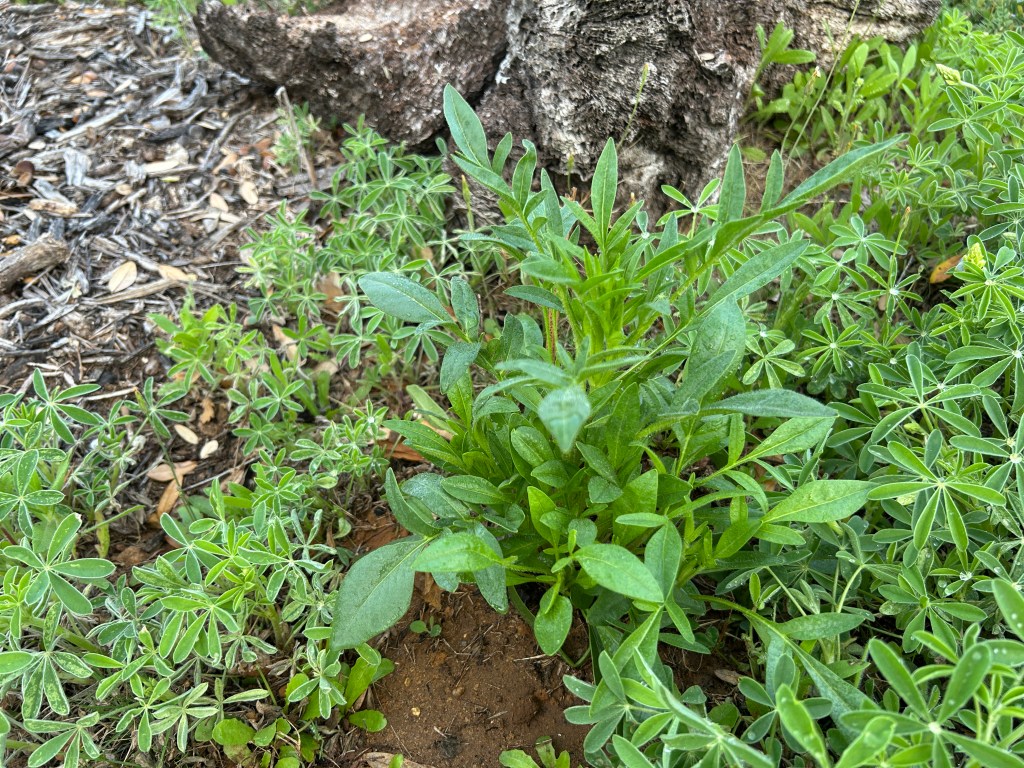
While I was shopping the H-E-B native plant sale, I found the annual Plains Coreopsis (Coreopsis tinctoria). I have already seen a few of these in the wildflower meadow in front of the house but since I like them, in order to boost their population I bought a pot and planted that near the sidewalk.
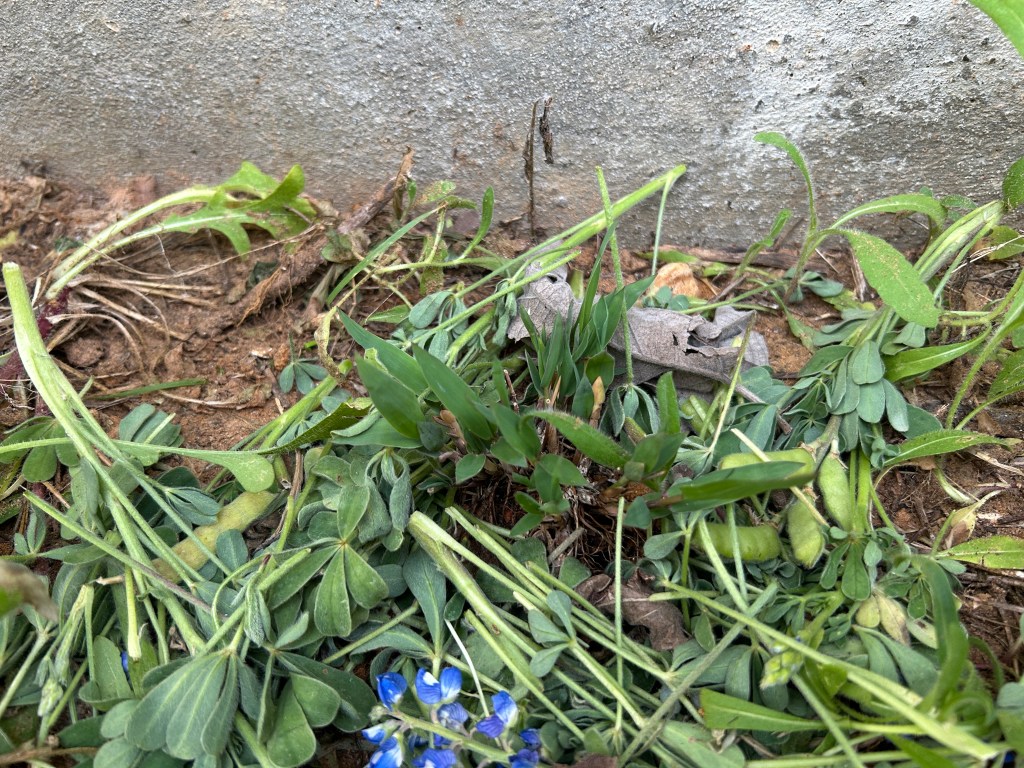
I already have one Inland Sea Oats aka Inland Wood Oats (Chasmanthium latifolium) plant here, in the hopes of starting a colony on the shaded north side of the house. I’ve also scattered some seed in the same area, but I am doubtful of the seed viability (I suspect the donor harvested them too soon). I happened to be at Green Jay Gardens, where there were some 4″ pots for sale so I bought one. Inland Sea Oats self-seed well, but my original plant is too young to have flowered yet. Adding another plant now perhaps doubles my chance for new plants next year!
The photo below probably needs some explanation. The spiky dark green leaves in the middle are the sea oats. Surrounding them are the tops of bluebonnet plants that were cut down from other parts of the garden where they were crowding something else too much. My policy here, where possible, is to “leave it on the site.” So plants that are cut down are usually used as mulch in some form, or composted.
Coming up soon is our local Native Plant Society of Texas plant sale. I cannot guarantee that I won’t be enticed by something there as well. It usually happens!

 Rewilding My Lot
Leave a comment