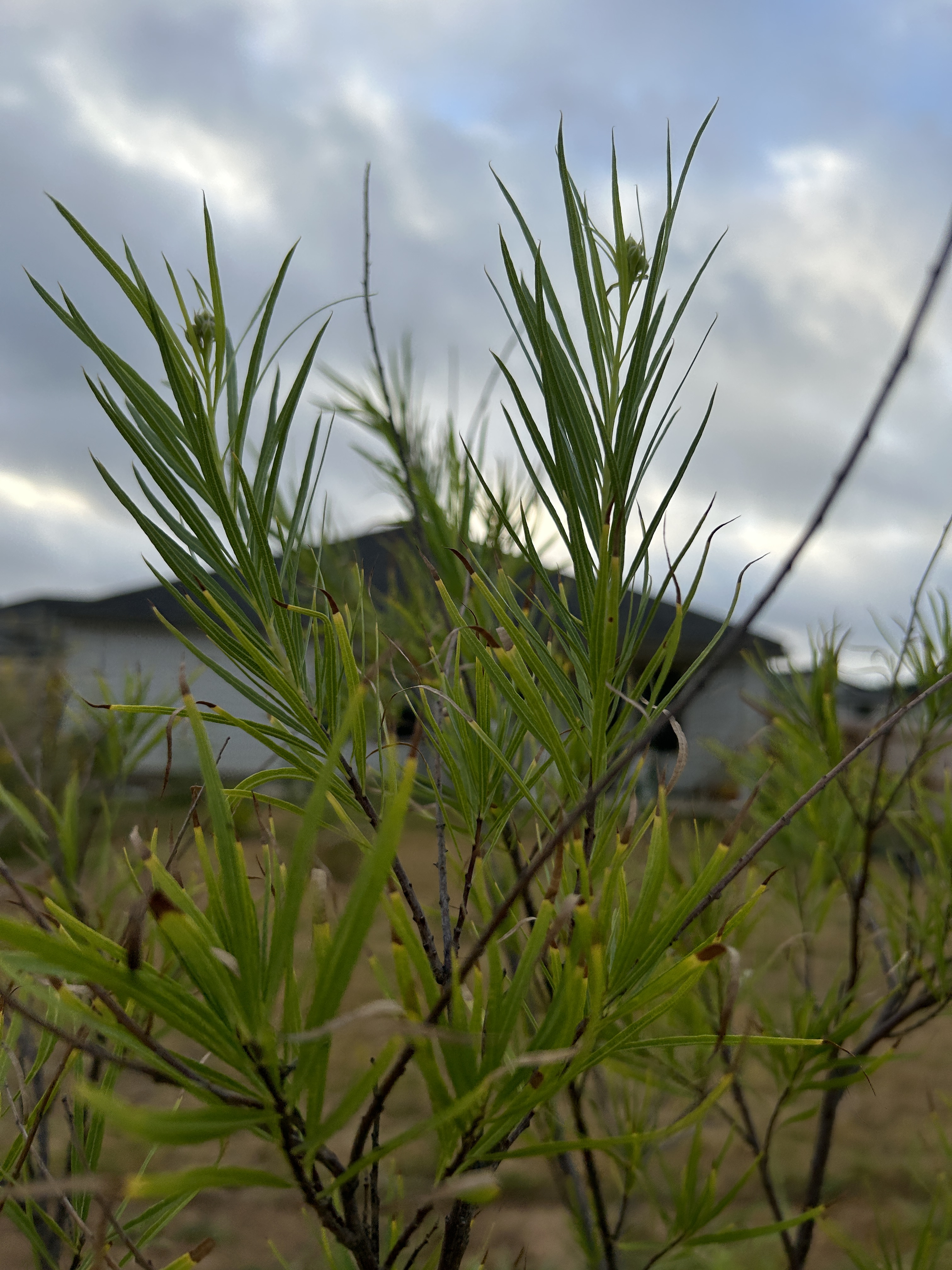
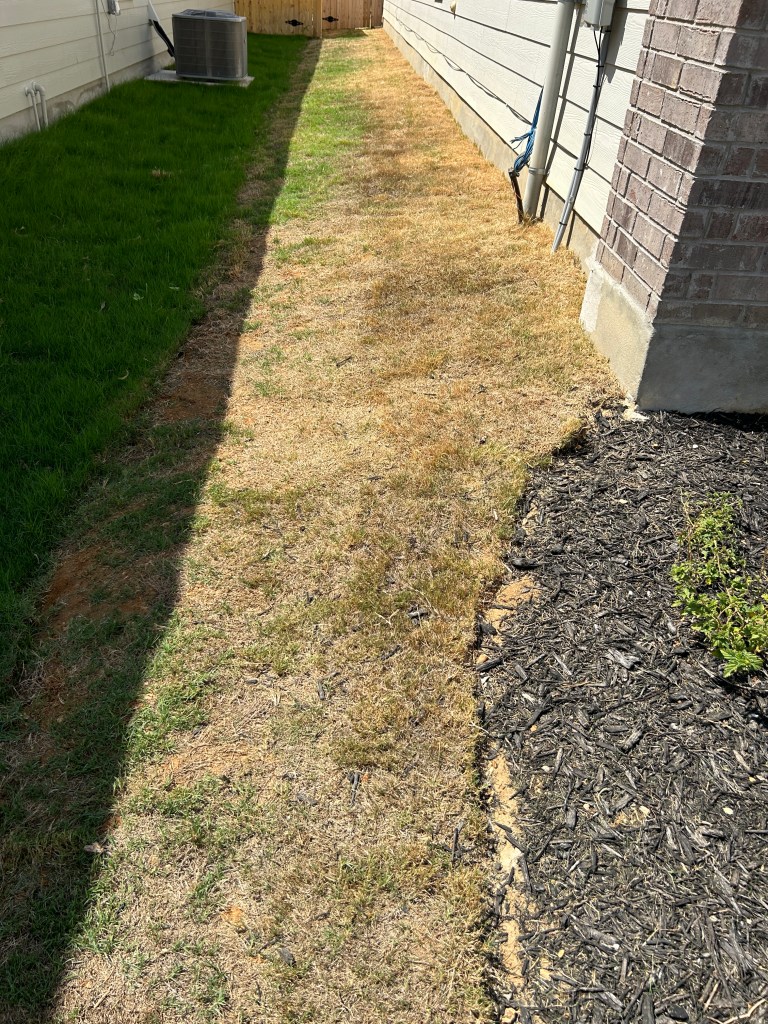
I struggle to find words adequately to describe how badly the Bermudagrass turf was laid here. It is very uneven, which means that ankles can turn when you walk on it, mowing is patchy, and anything on wheels is hard to push.
I am keeping the Bermudagrass in front of and beside the house, and I have a plan to make it more level. This will be safer for me, because I often walk across it to get to different places. It should also eventually look better.
Rather than tackle the whole area at once, as a pilot project I am going to work on the strip beside the south side of the house, which is my primary pathway between the front and back yards. Note that this area is sloped so that water does not pool at the foundation. This project is not to make the area horizontal, but rather to maintain the slope and yet make the surface more smooth.
Here’s the process:
- Mow or trim the grass as short as possible.
- Scatter soil.
- Use a leveling rake to even it out. This pushes the added soil into hollows without adding height to the raised parts.
- Over time, grass stems above (stolons) and below (rhizomes) ground grow into the patches with bare earth.
Sounds pretty straightforward, right? Let’s see.
I mowed as short as I could with my little mower on the bumpy ground, and then I cut the grass even shorter with my trimmer.
In some places stones were visible, so I pulled those out along with any weeds I could see.
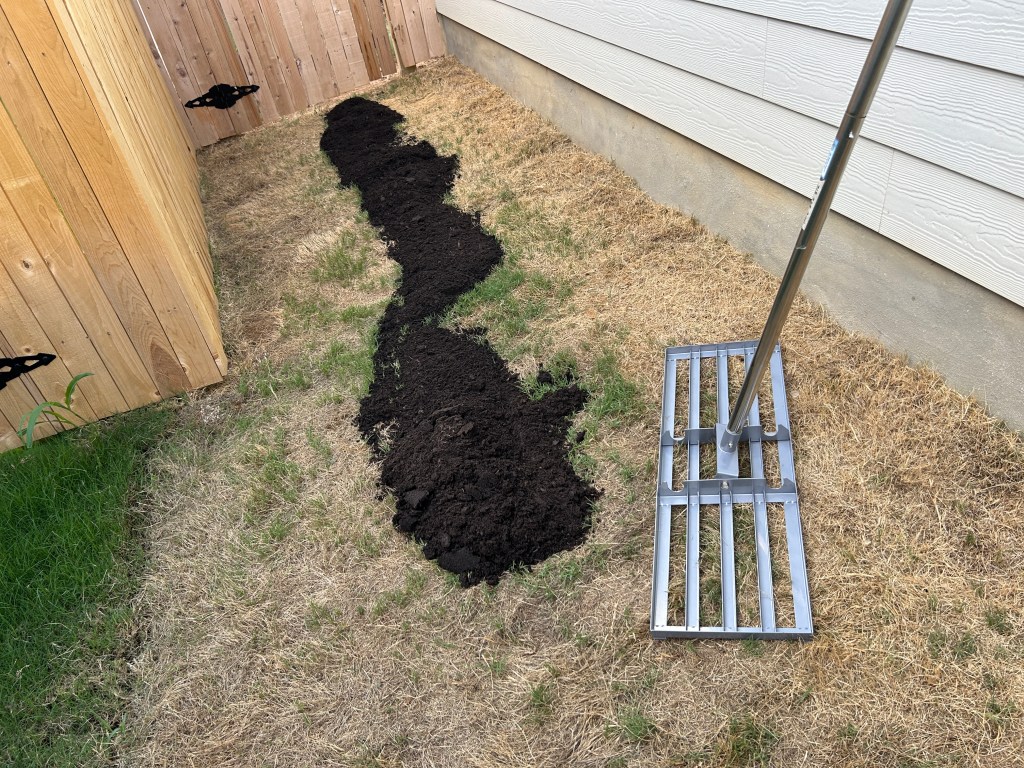
I routinely keep on hand bags of planting mix and compost. So for the purposes of this experiment I thought I’d try both. (Leveling can also be done with sand, but I wanted something more organic to replenish our poor soil.)
The first thing I found that the leveling rake was rather unwieldy for crude spreading, and I had an easier time using the back side of a regular rake first. Then once the new soil was spread around, the leveling rake could be used to flatten out the surface more evenly.
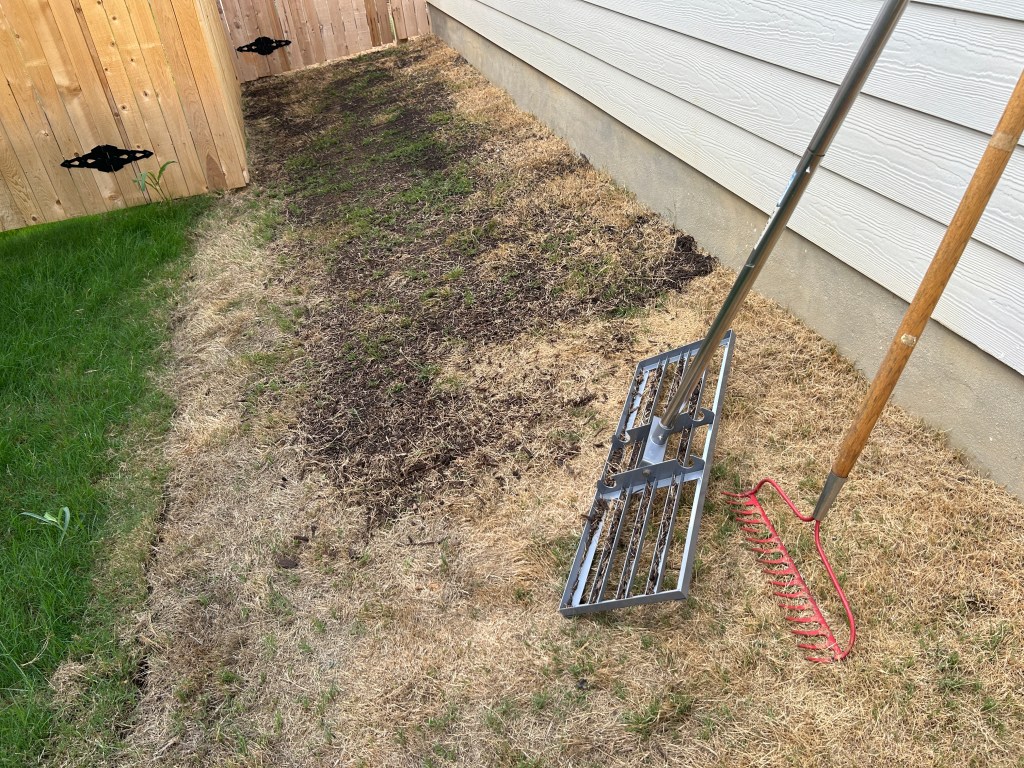
I knew that the surface was uneven, but I didn’t know to what extent. In other words, how much soil will I need? My original intent had been to address the entire width from the house to where the neighbor’s turf starts (new house, not sold yet), but once I saw how much soil was needed, I decided to limit this particular project to only the key strip on which I walk and wheel things
As a guide, I placed stone markers each time I used two 40-pound bags. To go from the back of the house to the front took seven bags. Two of those bags were compost, and the other five were planting mix soil. The soil texture was slightly finer, and I think better for this purpose.
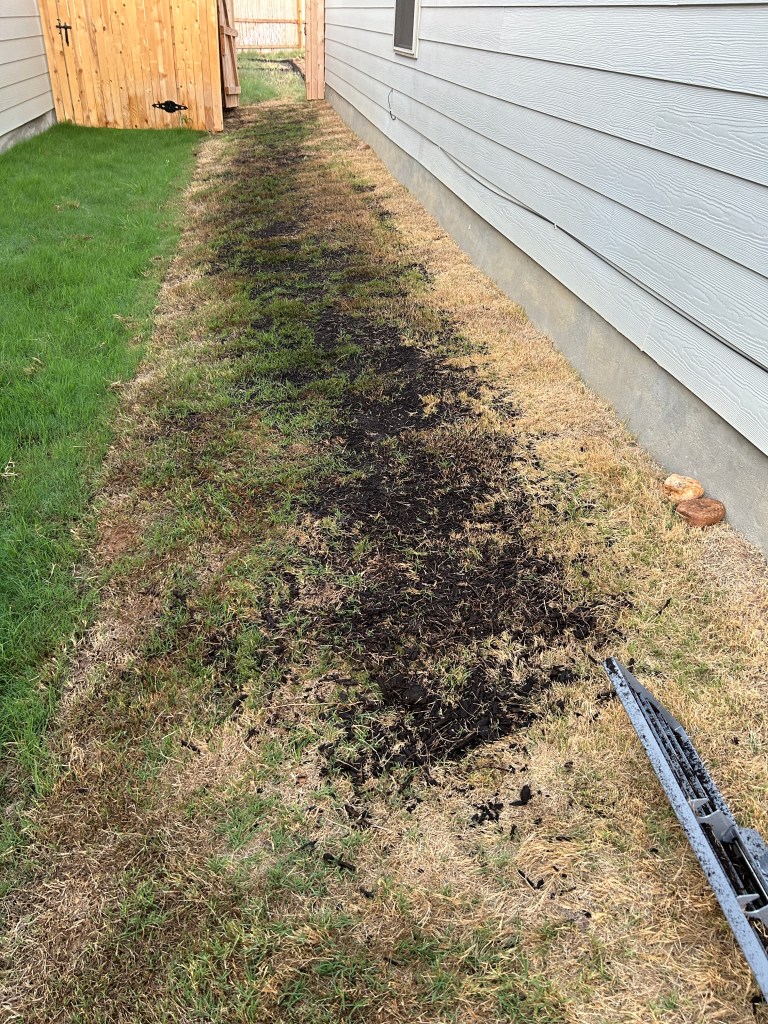
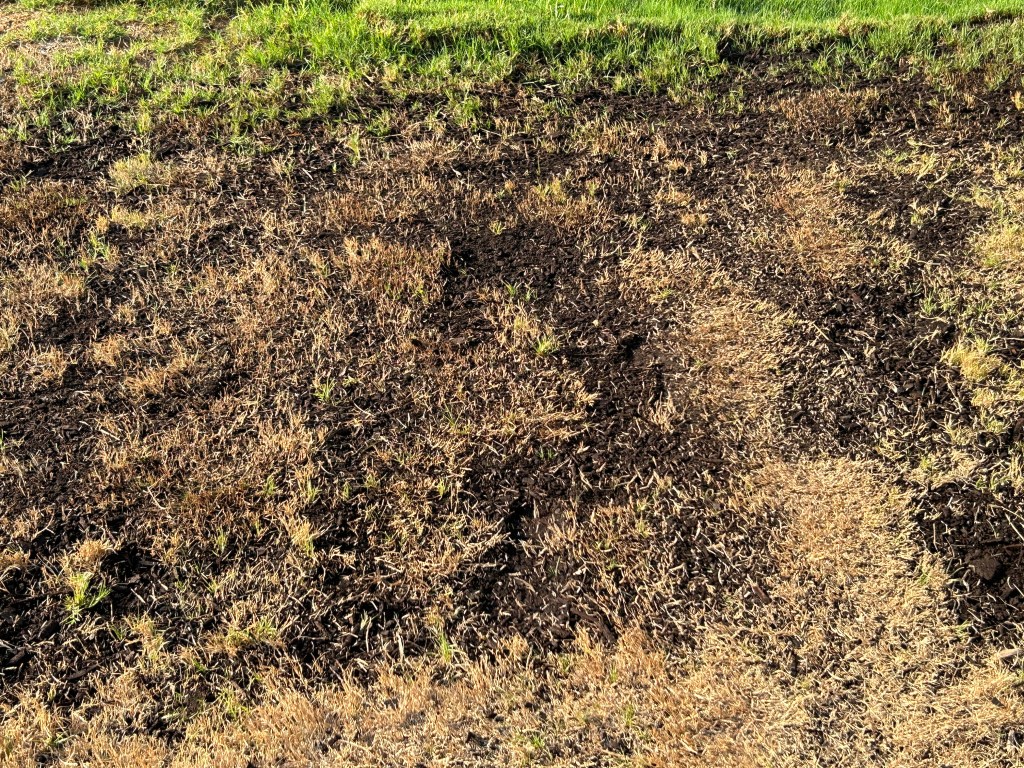
Certainly, the leveled surface is much easier and safer to walk on — it’s not perfect, but it is vastly improved. The procedure is pretty straightforward, although quite physical. The main limiting factor is that a lot of soil would be needed to do a complete job and I am therefore going to be making some compromises on what areas are most important to me right now and perhaps to tackle other areas in later months or years. Or maybe not at all.


 Rewilding My Lot
Leave a reply to We Finally Got Rain – Rewilding My Lot Cancel reply