
I had never grown corn before I started my Three Sisters Garden project this year, nor had I ever studied the structure and development of a corn plant.
Once my plants started to grow, it soon became apparent that things were happening that I didn’t understand so of course there had to be research. I found this textbook online, and there are several videos that describe the process, like this. Here is a very brief summary of what I’ve learned.
Corn plants have two key phases: a Vegetative phase, when the plant grows, and a Reproductive phase, when the plant makes ears of corn.
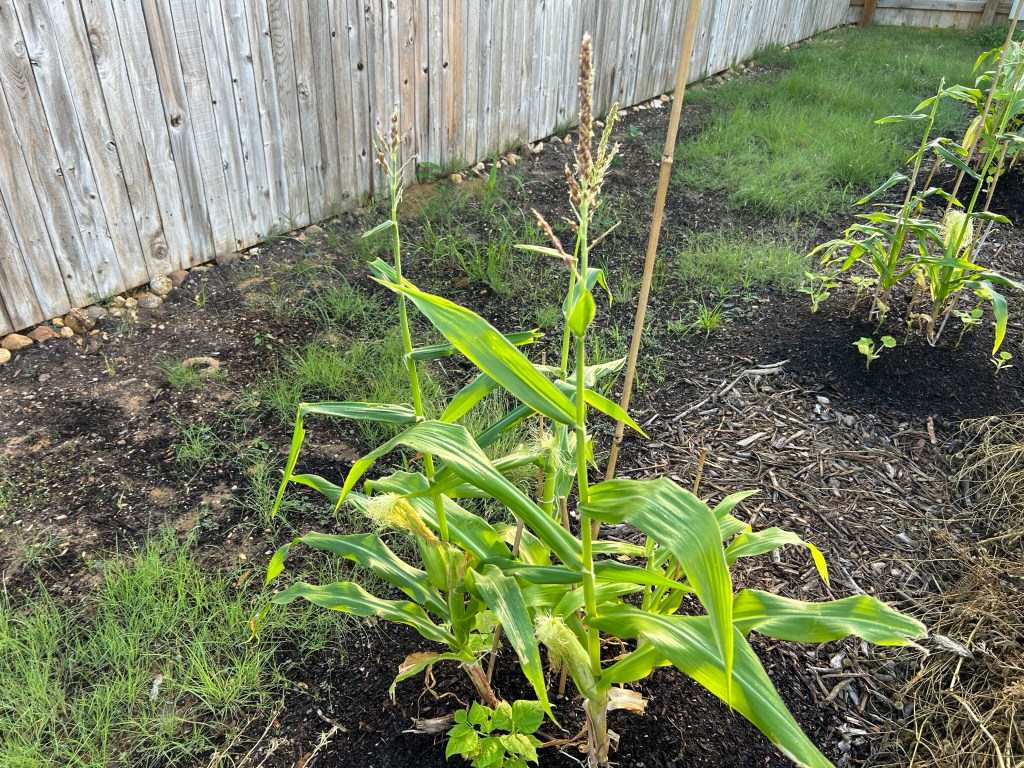
During the vegetative phase, the corn plant grows taller, with leaves growing out from nodes on the central stalk every few inches. At some of those leaf nodes, swellings (husks) form that are potential future ears of corn.
Once the plant has reached its final height, then a tassel emerges from the top of the main stem. This starts the reproductive phase. Silks emerge from the husks, one for each ovule (future kernel), and the silks continue to grow until they are fertilized. Pollen drops from the tassels onto the silks, and then pollen grains move along the silks, taking about 24 hours to reach the corresponding ovule where fertilization occurs and the ovule becomes a kernel. I had no idea that every kernel on a cob of corn had to be individually fertilized!
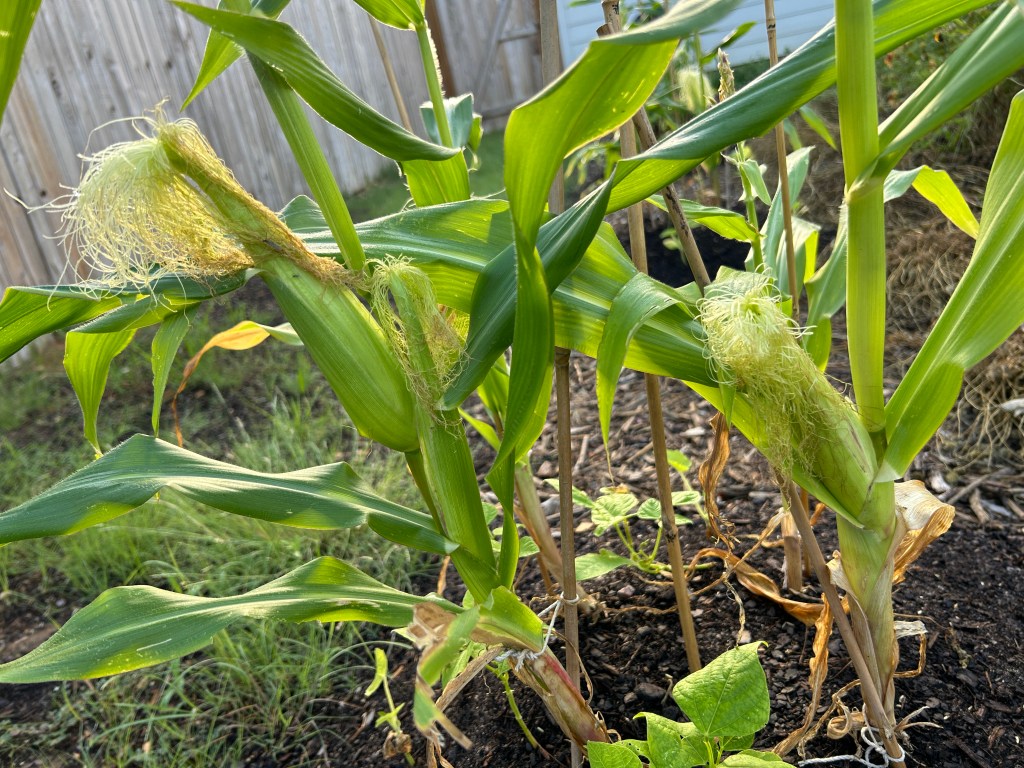
After fertilization, the kernels begin to grow out of the corn cob in a stage called Blistering. Subsequent phases are Milk, when starch begins to accumulate, and Dough, when the inner milky liquid thickens. Corn grown for grain goes through later drying phases, but I have sweet corn, which should be harvested when it’s still juicy.
How will I know when sweet corn is ready to eat? If you pick too early, the kernels will be hard because they won’t have had time to plump and ripen. And too late, the kernels will also be hard because they have begun to dry out. From this gardening site, I learned that the signs to look for are: (1) The silks are completely brown, dried out, and brittle.
(2) The ear is soft to the touch, and the tip is blunt instead of pointed.
and (3) The juice from the kernel runs milky white.
The time from the appearance of silks to sweet corn being ready to harvest is supposedly about three weeks.
There is a lot of corn being grown in fields near us, although I suspect that is corn being grown for grain. On those farms, I see large areas of corn plants that are a uniform height, with several husks per plant. My little plot, however, seems to be a study in irregularity and in one case, mutation (see below).
As of 5/17/2024, almost 9 weeks after planting corn seeds, I have 19 corn plants, 16 with tassels (on plants ranging in height from 17-49 inches), and 11 with husks that have silks emerging from them. The total number of husks that I can see is 12.
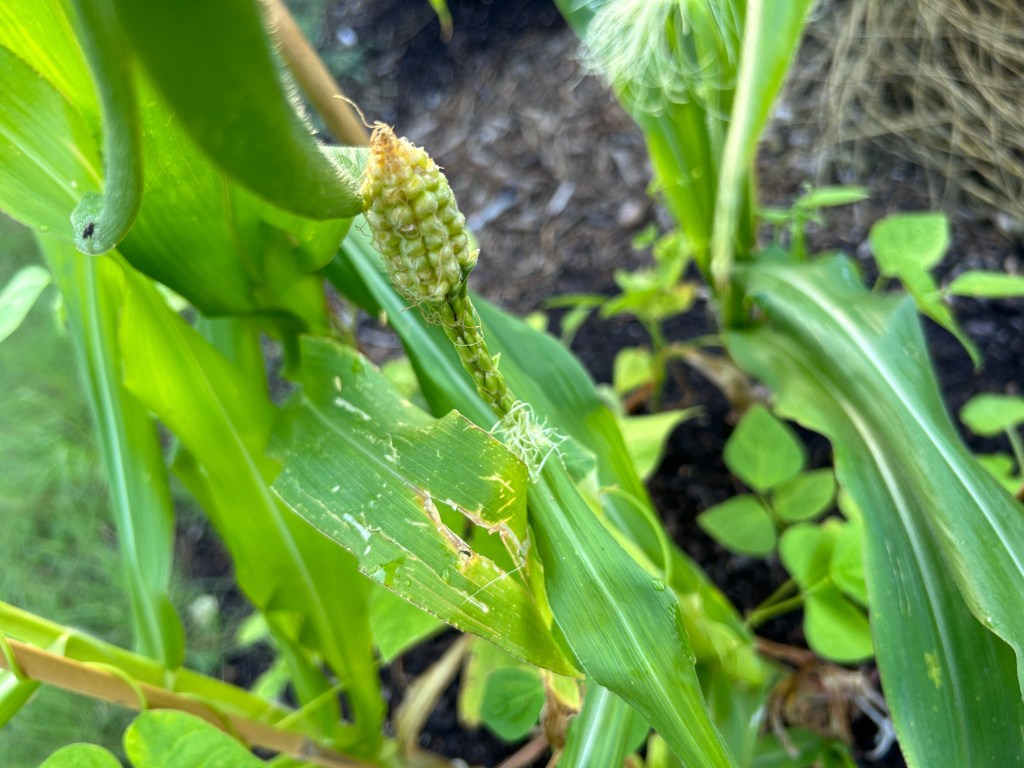
My corn plants seem mostly healthy, although underdeveloped in the sense that many of them seem shorter than would be expected and with not many developing husks. There is also the question of whether fertilization will even occur in my situation. In one peculiar case, a cob of corn is developing without a husk on top of a tassel — I’m pretty sure that’s not normal!
There are often poor yields in the first year of a vegetable garden because of immaturity of the soil, and I already know that I have very poor soil quality here. I will consider any harvest from this first Three Sisters Garden to be a bonus, and if nothing else, it is proving to be an interesting experiment and I certainly know more about corn now than I used to.


 Rewilding My Lot
Leave a reply to Three Sisters Garden Update – Rewilding My Lot Cancel reply