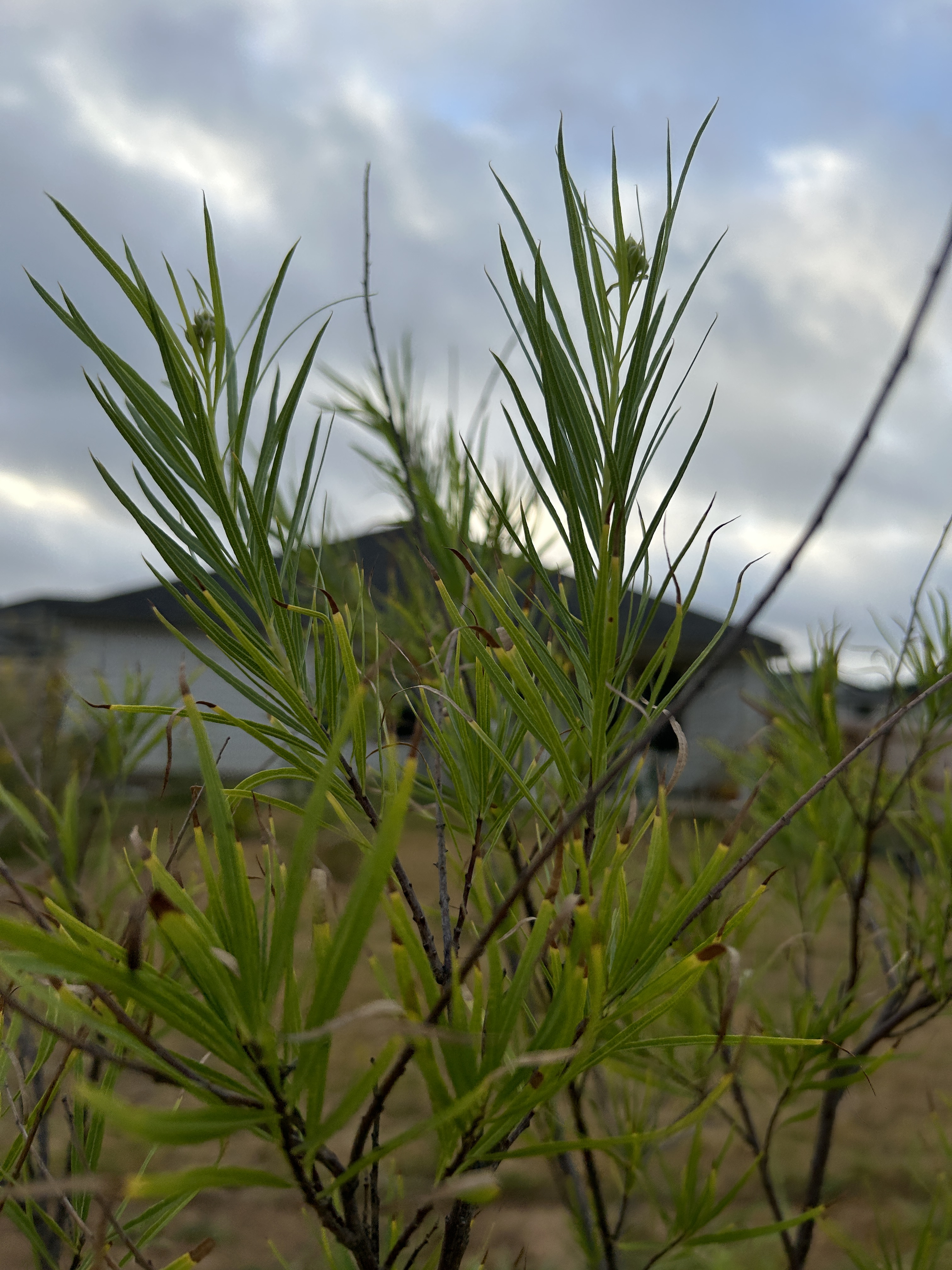
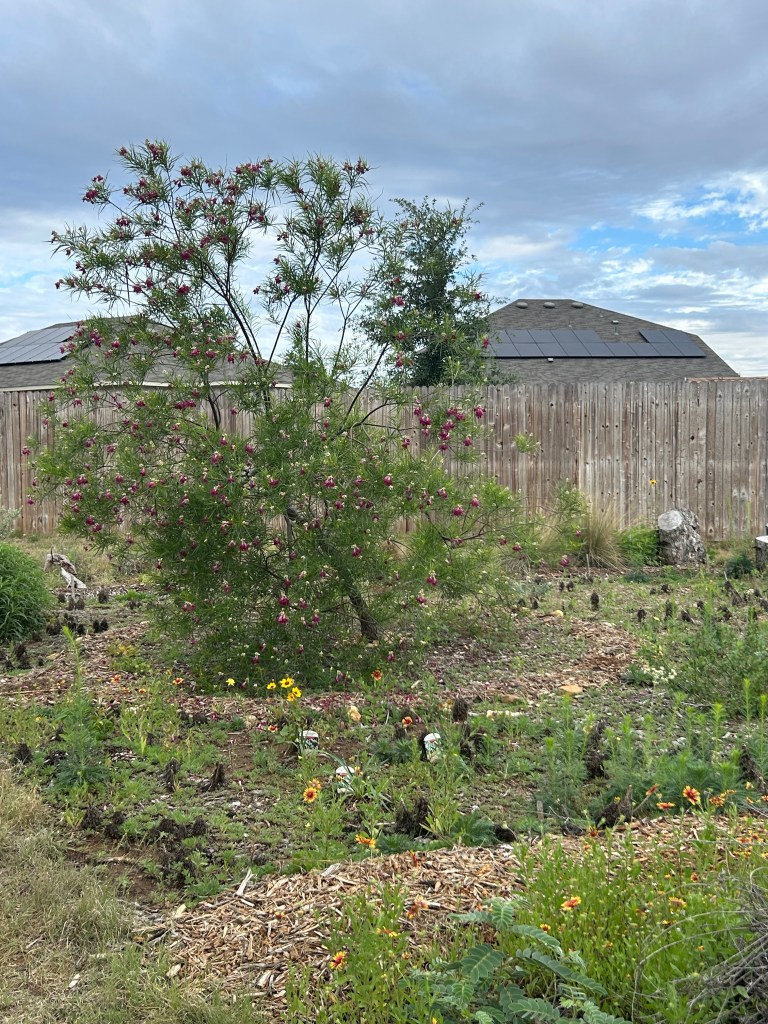
I am very fond of my Desert Willow (Chilopsis linearis) tree. It has grown the fastest, tolerates — even thrives on — our poor quality soil and limited water, has a long blooming season, and is beloved by hummingbirds and other pollinators. It has a flexible structure that moves gracefully when the wind blows. However, that last feature has consequences, as the rest of this post will show.
The Desert Willow was planted in spring 2023 and grew well. However, in September 2024, it appeared to be slowly toppling over. A friend built a brace to prop it up which stayed in place until January 2026 at which time I dismantled it, hoping that the tree would be anchored enough by then to stay upright.
However, just a few weeks later the tree started to lean over again. I noticed because branches were touching the ground that used not to.
So again I called in some strong help to set up a new support system. This time, instead of a brace to push the tree up, we installed three stakes to pull it. The brace had been causing some significant abrasion of the tree and the hope is that the stake system will be less damaging.
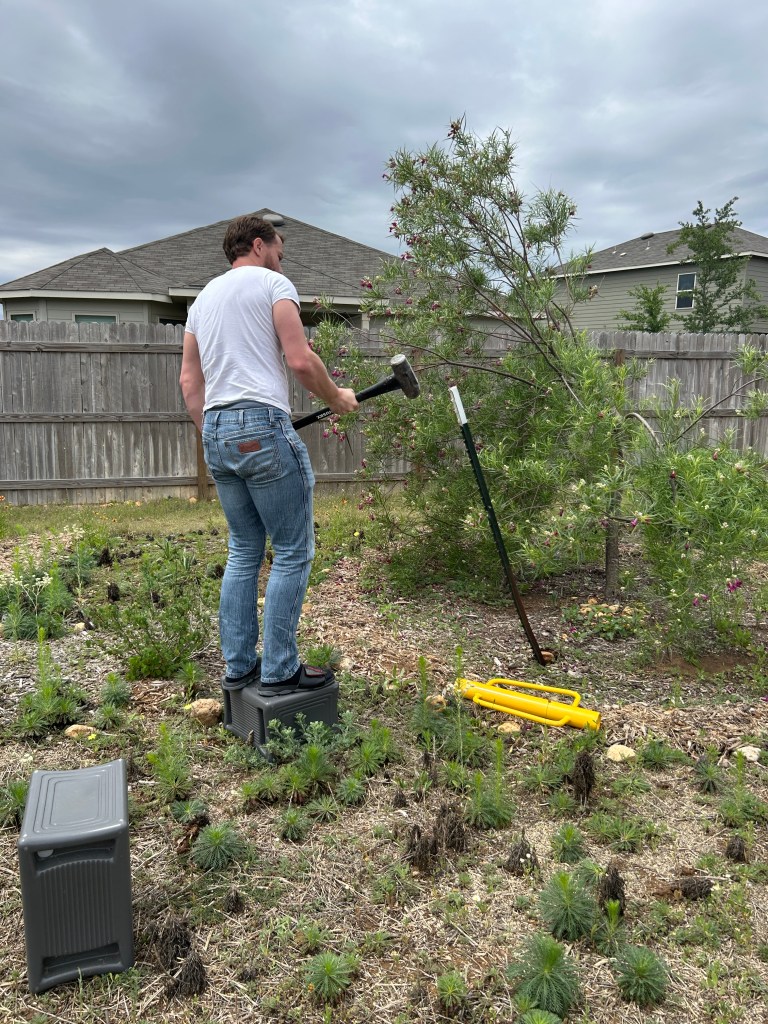
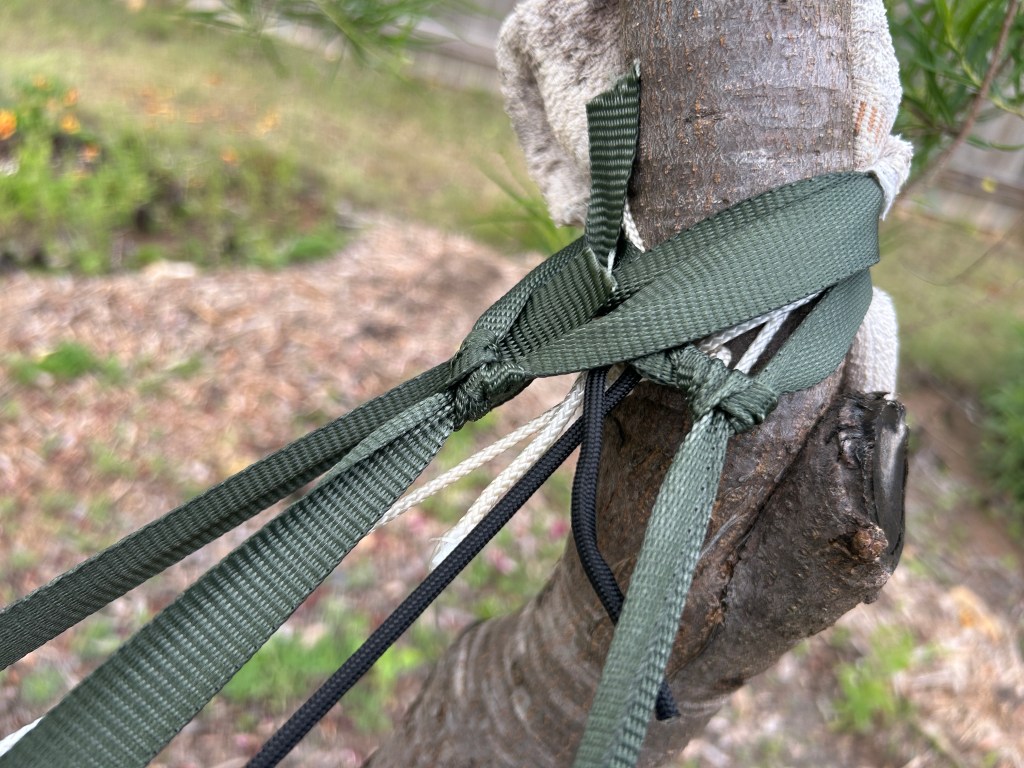
There are a lot of stones in our ground (a “gift” from the house builder), so hammering in the stakes was hard work. We wrapped the tree at the point of rope attachment with a towel and secured the posts at first with nylon rope, but a few days later I added tree webbing (I feared that wind movement might shear the rope that we had used). When we tied the tree and stakes together we used significant force to push the tree further upright. My assignment was tying the knots (bowline).
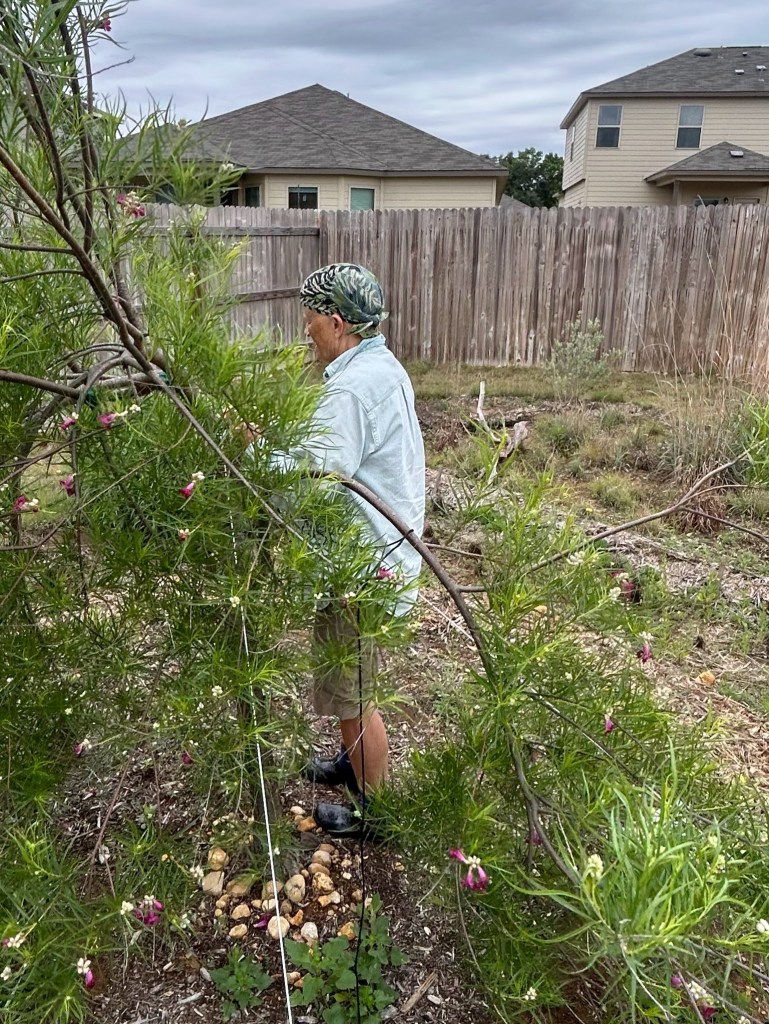
At the same time, I did some significant pruning of the tree to balance it better and reduce the number of branches that might catch the wind.
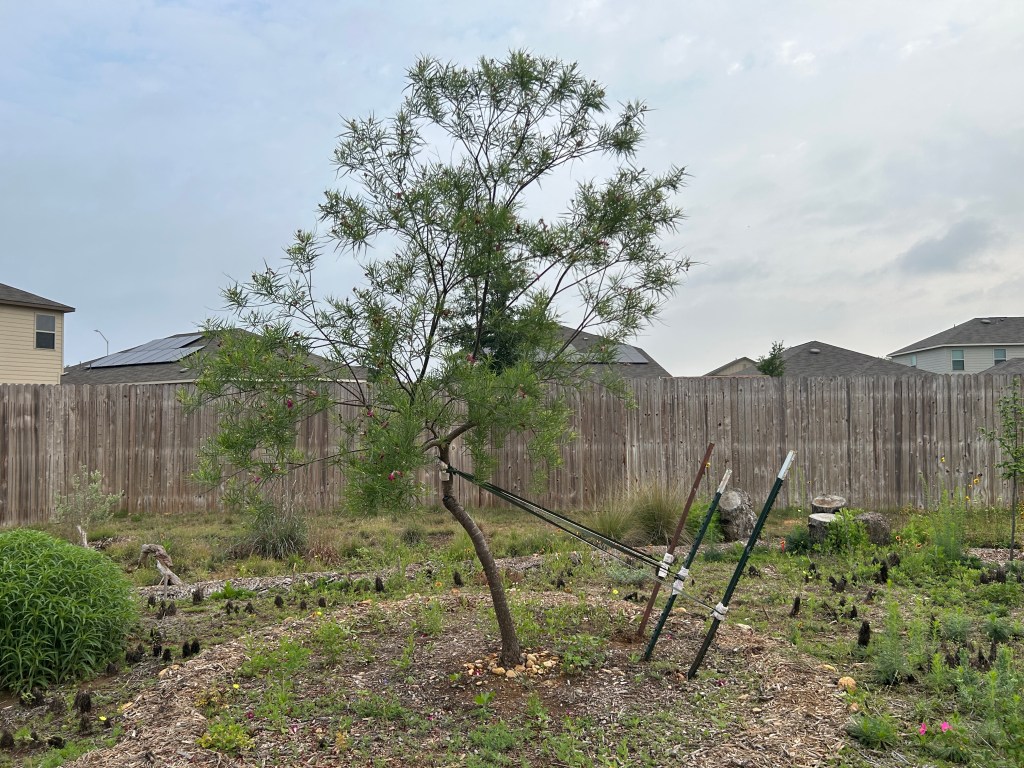
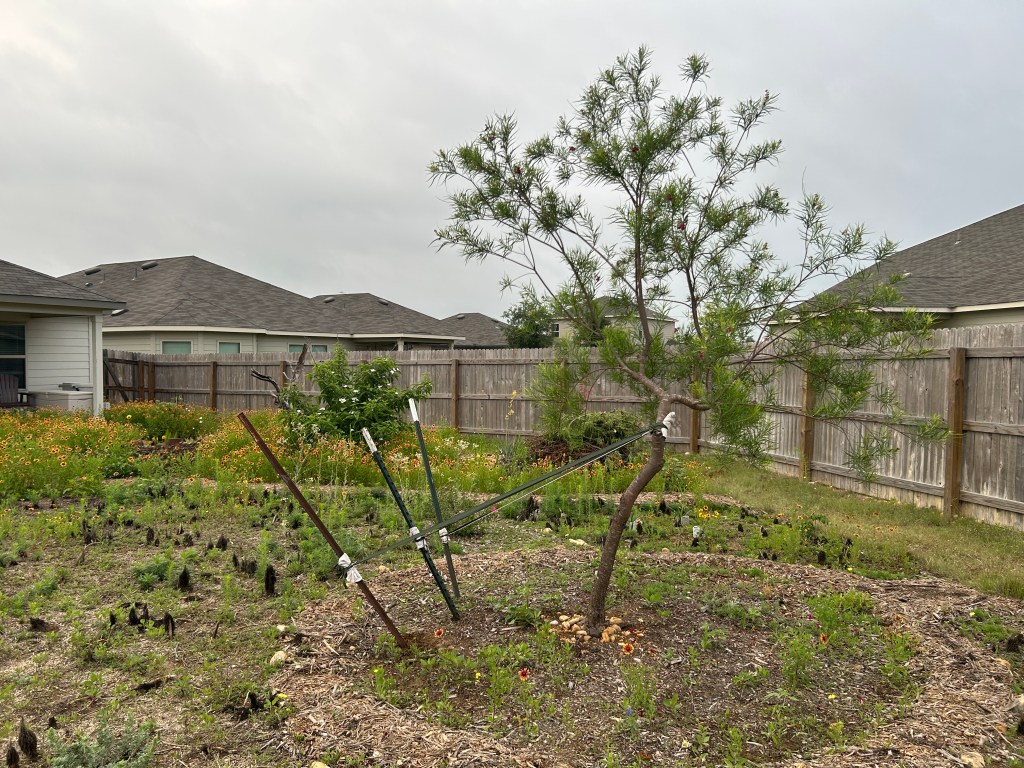
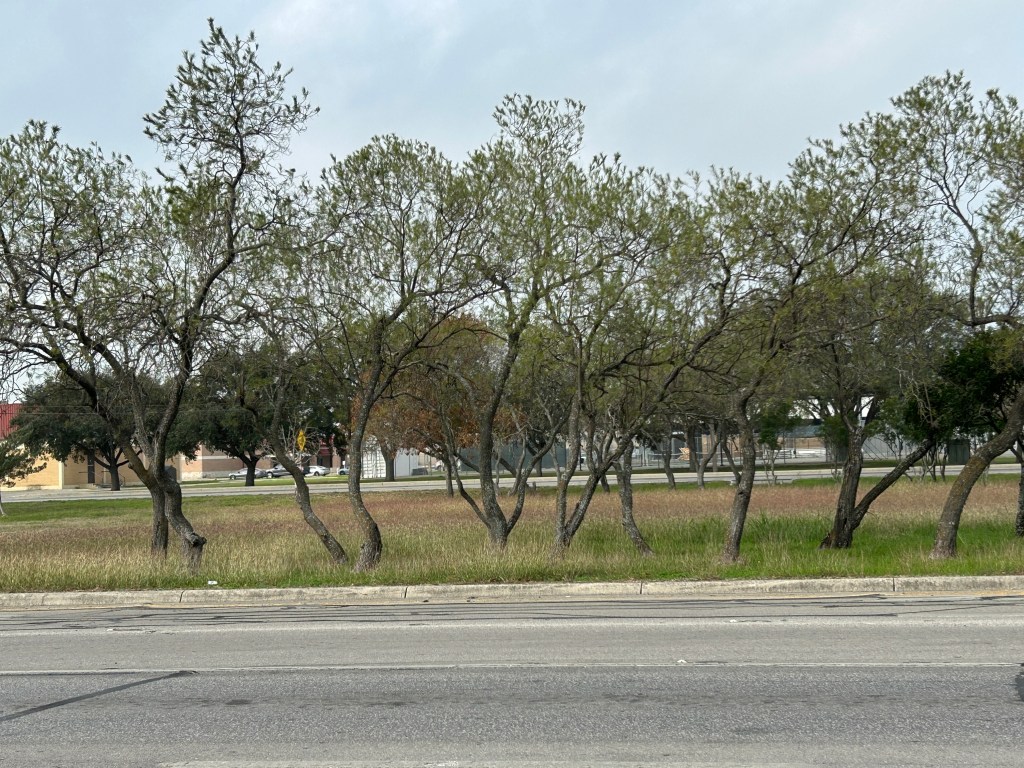
My guess is that the stakes will need to stay in place 2-3 years, although I might need to retie the webbing if the trunk expands too much during that time. Once the tree is finally stable, it will have an interestingly shaped trunk, but this seems to be a feature of Desert Willows, based on the several that are planted in medians close to here (example below).
After all that disruption to push the tree up and install support stakes, my plan was to give the roots a good soaking over several days to help them to heal. I was very fortunate in the timing of a major rainfall (5 inches) just a couple of days later, so that was perfect and I didn’t need to use a hosepipe.
Desert Willow is really the perfect tree for this particular environment. It prefers poor quality (well-draining) soil and neglect. So as I have watched it struggle with wind damage in its three years here, I can’t help but wonder if there was anything I did at the time of planting that has hindered the tree’s development. Certainly I was inexperienced and this was only the second tree that I had ever planted.
I’ve thought about that and gone back to look at photos from when I planted this tree. I don’t know that I did anything particularly wrong, but it has led me to ponder wisdom that I’ve gathered in the past three years about choosing and planting trees. It would have been helpful if I knew then what I know now!
- I know a lot more now about what makes a good (strong) tree structure and would be able to look at young trees and have some idea of how they might develop and/or need corrective pruning. When I bought this Desert Willow, it was the only one in the nursery at the time so I didn’t get to make any comparisons and pick the best.
- By the time I planted this tree, I had learned not to dig the hole too deep. However, looking at the early photos, I could have made the hole wider and I could have done more to agitate the roots to encourage them to grow away from the original shape of the pot as soon as possible.
- When I bought this tree, it was already 6 feet tall. It grew quickly and because of our high winds here, perhaps was blown around too much before the roots had grown strong enough to hold it in place. With hindsight, maybe this tree should have been staked for a year or two after planting. Or I might have chosen to plant a younger, smaller tree that could become more established before growing taller.


Leave a Reply